Elementary School
(Grade KG - 5th )
Table of Content:
Overview
Hamza Academy Elementary School provides a well-rounded education for students in grades KG – 5th. The goal of our school is to help students have a strong moral foundation using the teachings of Islam while having all the tools they will need to succeed in their academic and social endeavors. Our students will not only develop strong academic skills, but will also have a deep understanding of their Muslim identity created by instilling the love of the Quran and our Beloved Messenger of Allah, peace and blessings be upon him. Our school’s main emphasis is following the hadith of our Beloved Messenger of Allah, peace and blessings be upon him:
“The merciful will be shown mercy by the Most Merciful. Be merciful to those on the earth, and the One in the heavens will have mercy upon you.”
Our students are taught to be kind and merciful in words and actions to all those around them. We emphasize building character such as honesty, respect and kindness above all else so that our students can become positive role models for good character in their communities.
The goal of our Elementary School is to lay a solid foundation that inspires students to become eager learners, equipping them with the essential skills needed to build a successful future. We focus on the whole child so that every student is equipped to grow academically, emotionally and spiritually. From Quran reading and memorization to core subjects, every curriculum is carefully selected to ensure it meets the diverse needs of our students.
English Language Arts
Hamza Academy Elementary School provides a well-rounded education for students in grades KG – 5th. The goal of our school is to help students have a strong moral foundation using the teachings of Islam while having all the tools they will need to succeed in their academic and social endeavors. Our students will not only develop strong academic skills, but will also have a deep understanding of their Muslim identity created by instilling the love of the Quran and our Beloved Messenger of Allah, peace and blessings be upon him. Our school’s main emphasis is following the hadith of our Beloved Messenger of Allah, peace and blessings be upon him:
“The merciful will be shown mercy by the Most Merciful. Be merciful to those on the earth, and the One in the heavens will have mercy upon you.”
Our students are taught to be kind and merciful in words and actions to all those around them. We emphasize building character such as honesty, respect and kindness above all else so that our students can become positive role models for good character in their communities.
The goal of our Elementary School is to lay a solid foundation that inspires students to become eager learners, equipping them with the essential skills needed to build a successful future. We focus on the whole child so that every student is equipped to grow academically, emotionally and spiritually. From Quran reading and memorization to core subjects, every curriculum is carefully selected to ensure it meets the diverse needs of our students.
Mathematics
Our Mathematics program, built around the Go Math curriculum from HMH and aligned with New York State standards, is designed to help students develop strong number sense, problem-solving skills, and confidence in mathematics. In the early years, students begin by recognizing numbers, counting objects, and learning basic addition and subtraction using hands-on activities and visual models. They explore patterns, shapes, and simple measurement concepts, laying the foundation for more complex thinking.
As they grow, students deepen their understanding of place value, moving from tens and ones to hundreds and beyond. They practice addition and subtraction with larger numbers, begin to solve word problems, and use number lines and diagrams to show their thinking. Multiplication and division are introduced with concrete models, arrays, and repeated addition strategies. Students learn math facts and build fluency through games, practice, and real-world problem-solving. Fractions are introduced through visuals like number lines and fraction bars, helping students understand part-whole relationships.
As they progress, they compare fractions, add and subtract them, and relate them to decimals. Students also develop skills in measurement, working with time, money, length, weight, and volume using both customary and metric units. Geometry becomes more complex, as students classify shapes, understand angles, and explore symmetry and coordinate grids. Data and graphing are integrated throughout, teaching students how to collect, organize, and interpret information.
The curriculum emphasizes mathematical reasoning, encouraging students to explain their thinking and explore multiple ways to solve problems. Students engage in hands-on learning, partner activities, and digital tools to reinforce concepts in an interactive way. Vocabulary is consistently reinforced, helping students articulate their ideas using precise mathematical language. Math discussions and journaling are part of the routine, supporting communication and deeper understanding. Students are encouraged to take risks, persevere through challenges, and learn from their mistakes. The curriculum supports differentiated instruction, ensuring all learners are engaged and progressing. By the end of 5th grade, students have a solid foundation in arithmetic, number sense, geometry, measurement, and data, preparing them for middle school math with confidence and critical thinking skills.
Islamic Studies
At Hamza Academy’s elementary school, we are committed to delivering a well-rounded education that empowers students academically and spiritually. Through the Safar Islamic Studies curriculum, students embark on a meaningful journey of learning that nurtures their faith, character, and connection with Allah SWT. They begin by exploring the foundational beliefs of Islam, including the five pillars, the oneness of Allah, and the importance of following the Prophet Muhammad ﷺ. Lessons are taught in a way that is engaging and age-appropriate, using stories, activities, and discussions to bring Islamic teachings to life. Students learn daily dua’as, Islamic manners, and the value of good character such as kindness, honesty, and respect.
They are gradually introduced to the practices of wudu and salah, understanding both the steps and the spiritual meanings behind them. As they grow, students delve deeper into stories from the lives of the Prophets, learning lessons that guide them in everyday life. They study key aspects of Islamic history, including the lives of the Sahabah and the development of Islamic civilization. Students gain an understanding of halal and haram, the Islamic calendar, and the significance of months like Ramadan. They explore the importance of intention, sincerity, and maintaining strong moral values in all areas of life.
The curriculum also teaches the meanings of selected surahs and dua’as, encouraging memorization and reflection. Students build awareness of Islamic etiquettes in areas such as eating, speaking, dressing, and interacting with others. As they mature, they begin to address more complex topics like modesty, identity, peer influence, and responsibilities as young Muslims. Lessons also include an introduction to basic fiqh, the importance of salah in daily life, and the meaning behind worship. The curriculum fosters a deep love for Allah and His Messenger ﷺ, while promoting self-discipline and personal growth. Students are encouraged to think critically, ask questions, and apply what they learn to their own lives. The goal is to prepare them to live confidently as Muslims in the modern world, grounded in knowledge and guided by Islamic values. By the end of the program, students emerge with a strong Islamic foundation, a love for learning, and a desire to continue growing in their faith.
Science
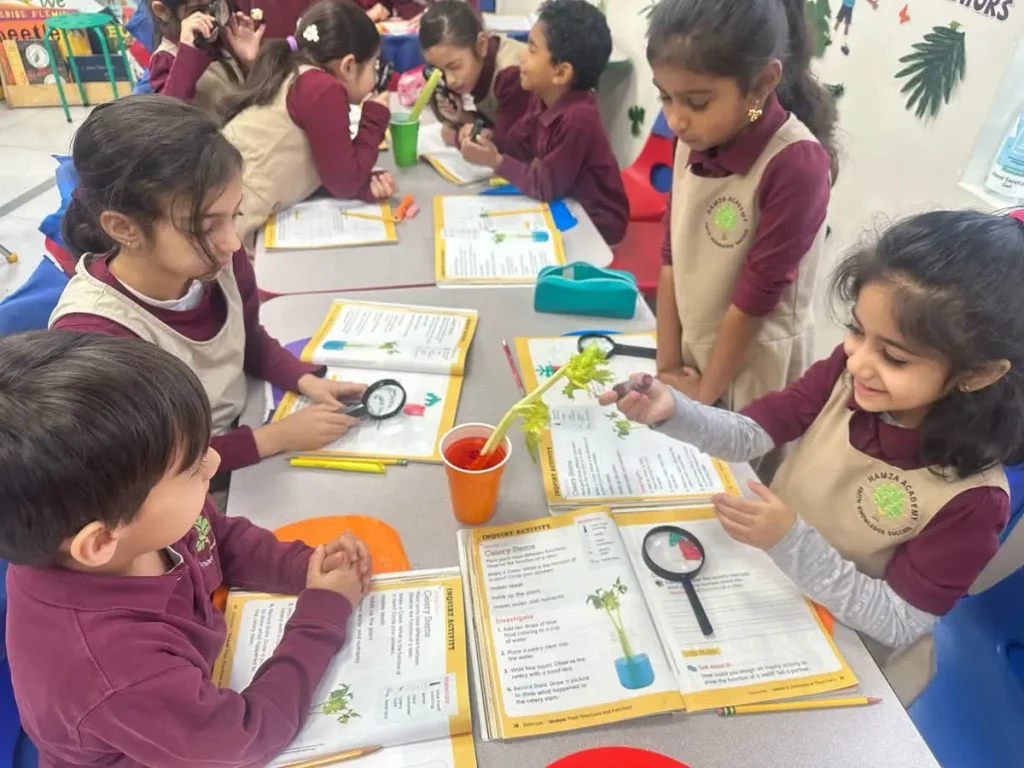
Our science program, guided by the Inspire curriculum from McGraw Hill and aligned with the NGSS, helps students develop a deep understanding of the natural world through inquiry, observation, and hands-on learning. In the early years, students explore basic science concepts by observing plants, animals, weather, and the environment around them. They learn to ask questions, make predictions, and use simple tools to investigate. As students grow, they begin to explore life science topics such as life cycles, habitats, and the needs of living organisms.
They study Earth science concepts like the sun and moon, landforms, natural resources, and the weather and seasons. Physical science units introduce them to matter, energy, motion, light, sound, and simple machines. Students learn how things move, how materials change, and how energy flows through systems. Throughout all grade levels, students practice the scientific process—observing, experimenting, recording data, and drawing conclusions.
Engineering and design challenges are woven into the curriculum, encouraging creativity, collaboration, and problem-solving. Students learn to think critically and use evidence to support their ideas. The curriculum promotes scientific literacy by connecting lessons to real-world applications and environmental awareness. Digital tools and interactive activities help engage students and support different learning styles. As they progress, students gain confidence in using scientific language and reasoning. By the end of 5th grade, they have built a solid foundation across life, physical, and earth sciences and are well prepared for more advanced scientific learning in middle school.
Social Studies
Our Social Studies program, guided by the Impact curriculum from McGraw Hill, helps students develop a strong understanding of their communities, country, and the world around them. In the early grades, students begin by learning about themselves, their families, and the roles people play in a community. They explore important concepts like rules, responsibilities, fairness, and the importance of working together. Students are introduced to basic geography by learning about maps, globes, landforms, and how to identify places in their neighborhood and beyond. They also learn about national symbols, holidays, and historical figures who have contributed to the United States.
As students progress, they begin to study U.S. history, government, and economics in greater depth. They explore how communities change over time, the development of early civilizations, and how the past shapes the present. Students learn about state and national government, the Constitution, and the importance of citizenship. Economic lessons introduce them to needs and wants, goods and services, trade, and decision-making. Geography lessons continue to expand with a focus on regions, natural resources, and how humans interact with their environment. Through biographies and historical narratives, students learn about diverse cultures, leaders, and movements that have shaped society. The curriculum includes critical thinking activities that encourage students to analyze sources, compare perspectives, and make informed decisions. Students are taught to respect different cultures, appreciate diversity, and understand their role as active citizens. By the end of 5th grade, students have built a strong foundation in civics, history, geography, and economics, preparing them for more in-depth studies in middle school.
Technology
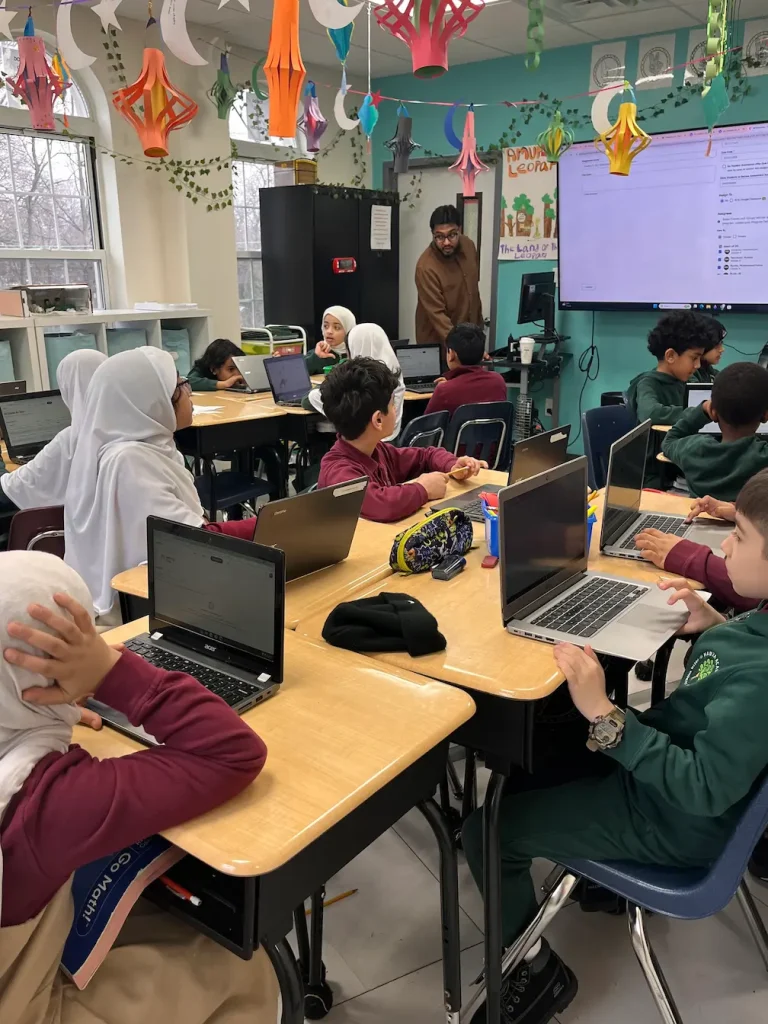
Our Technology program, aligned with New York State standards, provides students from Kindergarten through 5th grade with the foundational skills needed to thrive in a digital world. In the early years, students learn basic computer parts, how to safely use devices, and how to navigate educational software and tools. They begin to develop fine motor skills through mouse control, touchscreen use, and basic typing. As they progress, they are introduced to responsible technology use, including digital citizenship, internet safety, and how to make respectful choices online. Students explore educational apps and programs that support creativity, problem-solving, and collaboration. By using age-appropriate tools, they create digital art, simple documents, and presentations to express ideas. Keyboarding is introduced and reinforced through engaging exercises that build typing fluency and accuracy.
Students also begin to explore coding through block-based programs, learning sequencing, loops, and basic programming logic. Across the grades, students are encouraged to use technology as a tool for research, communication, and innovation. They learn how to gather information, evaluate sources, and present their findings in clear, digital formats. Problem-solving and design-thinking are emphasized through STEM-based activities and technology challenges.
Collaboration and communication tools are introduced to help students work together on group projects. Throughout the program, students are taught to be responsible digital citizens, understanding the impact of technology on themselves and others. By the end of 5th grade, students are confident, creative users of technology who are prepared to take on more advanced digital learning in middle school.
Arabic
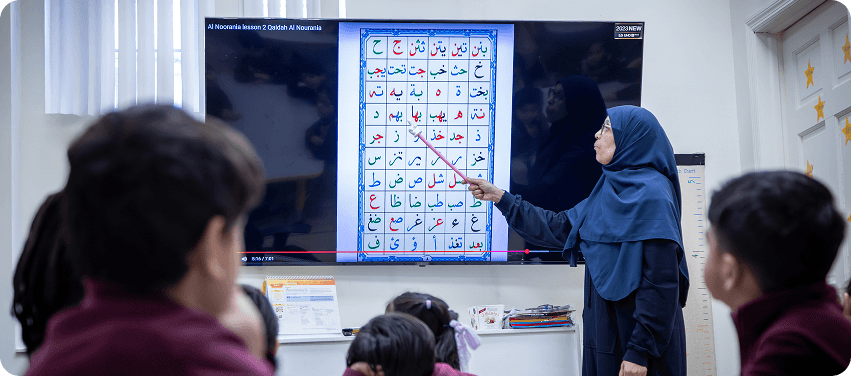
Our Arabic program is designed to build strong foundational language skills while nurturing a love for the Arabic language and culture. In the early years, students are introduced to the Arabic alphabet, learning to recognize, name, and pronounce each letter. They begin to identify letter shapes and sounds in isolation and within words through fun, interactive activities. Basic vocabulary is introduced using themes such as colors, numbers, animals, family, and classroom objects. Students learn common greetings, simple sentences, and basic conversation skills to express themselves in everyday situations. Nasheed, stories, games, and visuals help reinforce vocabulary and pronunciation in an engaging way.
As they progress, students begin to blend letters to form words and gradually read simple sentences. Writing skills are developed step-by-step, starting with tracing and progressing to writing words and short phrases. Listening and speaking are emphasized through classroom dialogue, role play, and listening activities. Students continue to expand their vocabulary and comprehension through thematic units and age-appropriate reading passages. Grammar is introduced in simple forms, such as identifying nouns, verbs, and pronouns, and using them in context.
Cultural elements are woven into lessons to help students appreciate the richness of Arabic-speaking cultures and traditions. Students also learn basic Islamic vocabulary and terms to help them connect the language to their faith. Through consistent practice and immersion, students gain confidence in reading, writing, listening, and speaking. By the end of 5th grade, students are able to understand and use Arabic in a variety of simple conversational and academic contexts, preparing them for more advanced language learning in the upper grades.
Visual Arts
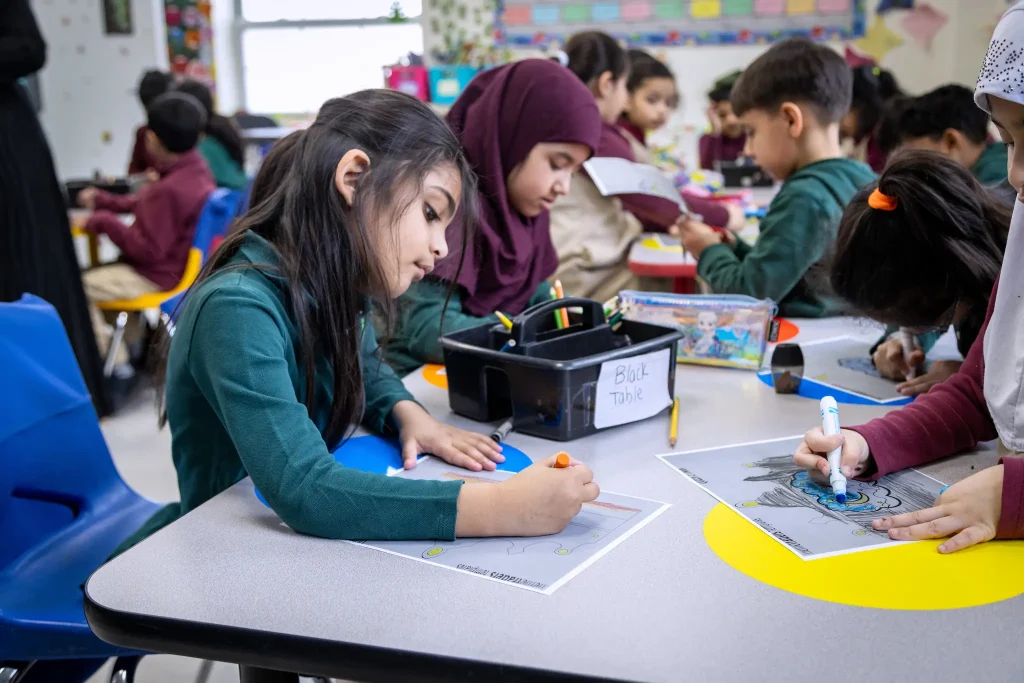
Our Visual Arts program, guided by the New York State Learning Standards for the Arts, helps students develop creativity, self-expression, and an understanding of the artistic process. From the earliest grades, students begin exploring the basic elements of art, such as line, shape, color, texture, and form. They experiment with a variety of materials and tools including crayons, paint, markers, pastels, clay, and paper. Students learn to make choices in their artwork and understand that art is a form of personal expression.
As they grow, they are introduced to key artistic concepts like pattern, balance, contrast, and symmetry. They begin to plan and revise their work, developing problem-solving skills and creative thinking. Students explore the works of well-known artists from different cultures and time periods, helping them understand how art reflects people, places, and history. They respond to artwork by discussing how it makes them feel and what it might mean, building visual literacy and vocabulary.
Lessons often connect to classroom themes in social studies, science, or literature to support cross-disciplinary learning. The curriculum encourages students to reflect on their artistic choices and describe their creative process. Students learn to work independently and collaboratively, respecting their own work and the work of others. They are introduced to various artistic techniques and styles as they progress through the grades. By the end of 5th grade, students have built a strong foundation in both the technical and expressive aspects of art. They are confident in using art as a tool for communication, imagination, and cultural understanding.
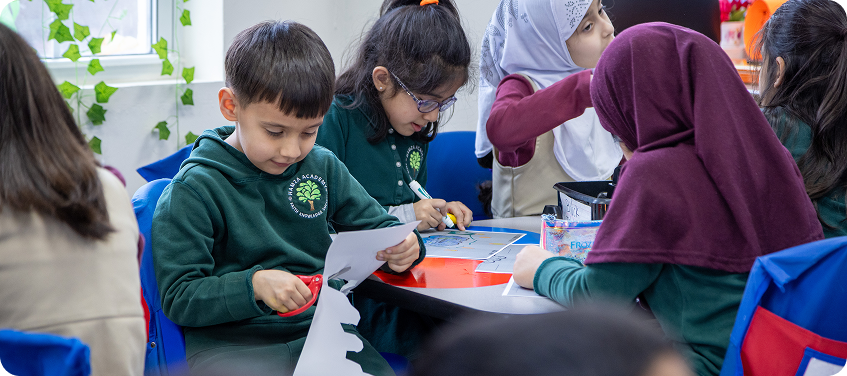
Health and Physical Education
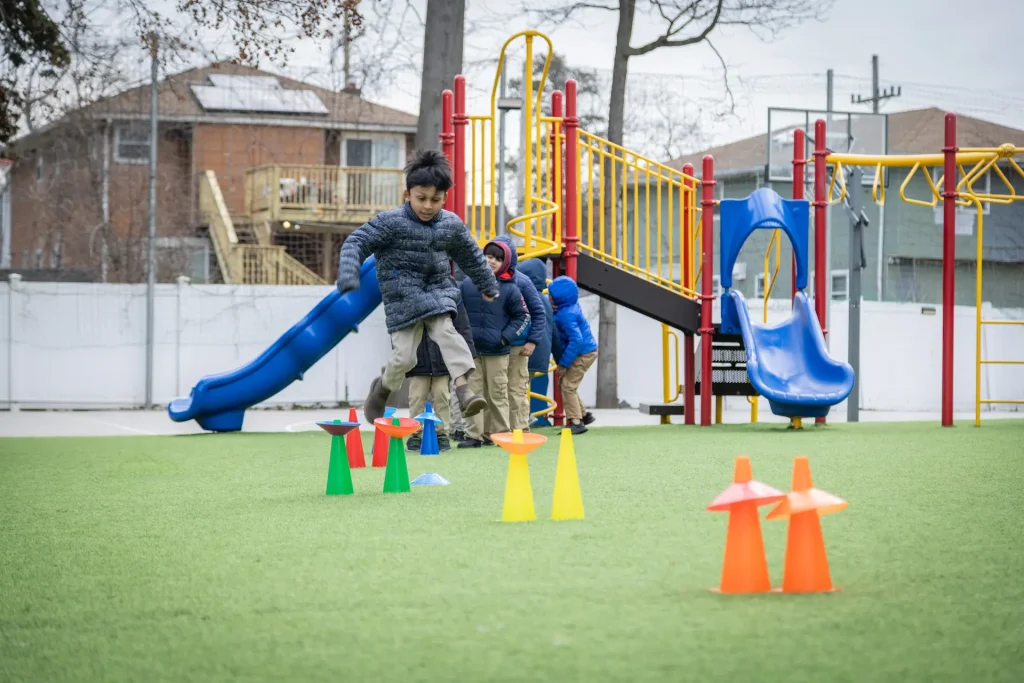
Our Health and Physical Education program, based on the New York State Standards, helps students develop physical fitness, health awareness, and essential life skills. In the early years, students focus on basic movement skills such as running, jumping, balancing, and throwing, while developing coordination and body awareness. They are introduced to the importance of physical activity for overall health and well-being.
As they progress, students engage in activities that promote teamwork, sportsmanship, and cooperation. They learn how to follow directions and work with others in both individual and group activities. Physical education classes emphasize the development of fundamental motor skills, such as kicking, catching, and dribbling, that students can build upon as they grow.
Health education begins with teaching students about personal hygiene, nutrition, and the importance of staying active and healthy. Students explore topics like healthy eating, the effects of exercise, and how to make good choices to maintain physical and mental health. They also learn about safety in both everyday life and during physical activities, including the importance of warm-up and cool-down exercises.
As students move into upper elementary grades, they study more specific health topics like understanding emotions, stress management, and making responsible decisions. They also explore the importance of self-care, including sleep, hydration, and managing screen time. Physical education activities become more structured, and students are introduced to various sports and games that focus on skill development, fitness, and healthy competition. They are encouraged to set personal fitness goals and track their progress over time. By the end of 5th grade, students have a solid understanding of physical health, wellness, and fitness, and they are equipped with the knowledge to make positive health choices and stay active throughout their lives.
Al- Qura’n
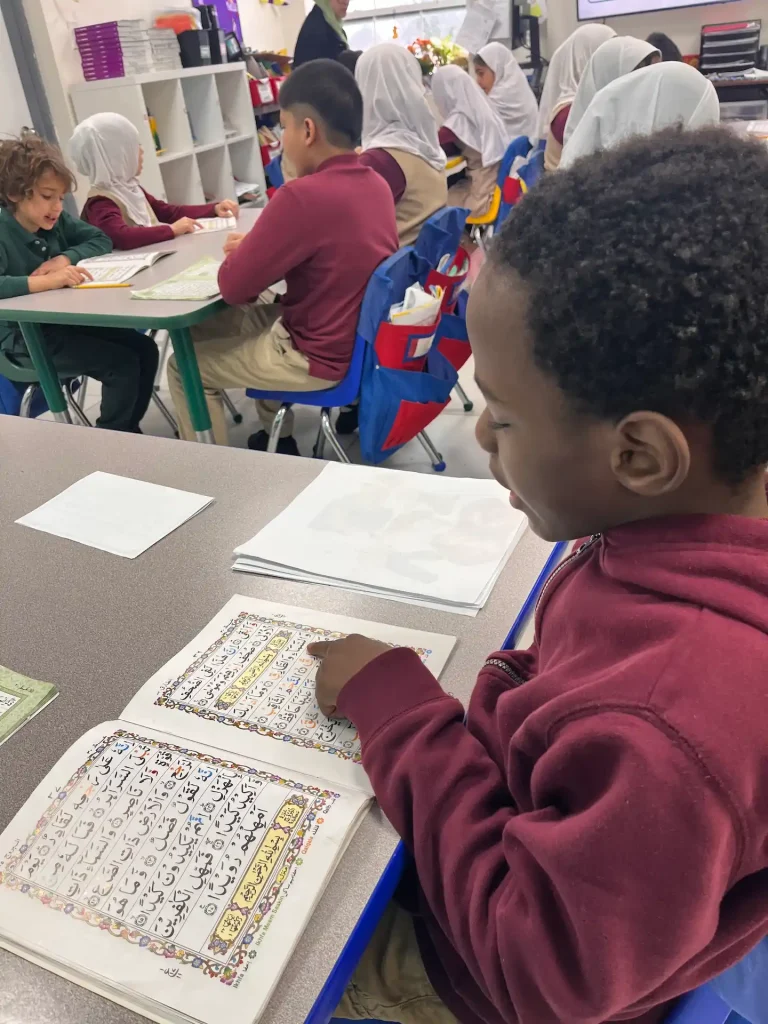
The main goal of our Quranic studies program in elementary school is to instill a love for the Quran and its teachings into the hearts of our students. Our program focuses on reading, memorization, tajweed rules and age appropriate tafseer. Our goal is to have our students memorize Juz Amma, Last ten ayahs of Surah Al Baqarah, first ten ayahs of Surah Kahf by the end of elementary school. Students also learn proper Quran recitation techniques i.e. Tajweed rules such as Huroof Al Madd, Qalqala letters etc. Students not only memorize the verses, but child friendly translation and tafseer is also introduced. They participate in hands-on art projects related to the verses they are studying and extrapolate lessons they can apply in their everyday lives.
Quran Syllabus
Kindergarten

Quran: Surah Al-Fatihah, Quraish, Al Feel, Al-Humzah, Al-Asr, At-Takathur, Al-Qariah, Al-'Adiyat, Az-zalzalah, Al-Baqarah v.( 255)
Al Qaida Al Noorania: Lessons 6 - 10
Grade 1
Quran: Surah Al-Fatihah & Al-Baqarah v. 255(Revision), Surat Az-zalzalah , Al Bayyinah , Al Qadar, Al-Alaq, At-tin, Ash- sharh, Ad-Duha
Al Qaida Al Noorania: Lessons 11 – 17,
Tajweed : Rules of QalQalah ,Rules of noon Sakina and tanween, Rules of Al-Ghunnah
Grade 2
Quran: Surah Al-Fatihah & Al-Baqarah (v. 255, v. 285-286(Revision), Surat Al Layl, Ashams, Al-Balad, Al- Fajr , Al-Ghashiyah, Al-Ala.
Al Qaida Al Noorania: Lessons 11 – 17 (Revision)
Tajweed : Rules of Ghunnah , Rules of Qalqalah, Rules of Waqf
Grade 3
Quran: Surat Al A'la & Al-Baqarah (v. 285-286) (Revision) , At-tariq, Al Buruj , Al-Inshiqaq, Al-Mutaffifin
Al Qaida Al Noorania: Lessons 11 – 17 (Revision during Sep)
Tajweed : Makhaarij Al-Huroof (Revision) , Rules of Waqf, Rules of Laam, Rules of Raa.
Grade 4
Quran: Al-Infitar & Surah Al-Baqarah (v. 285-286) (Revision) , At-Takwir, Abasa, An-Naiat, An-Naba.
Tajweed: Rules of Waqf & Rules of Madd ( Revision) , Rules of Laam, Rules of Raa, Rules of HamzatulWasl (Identify Rules of The definite article (ال (with the moon letters)
Grade 5